
The South-East direction holds a special place in Vastu Shastra because it represents the Fire element (Agni Tatva). This zone is linked with energy, cooking, enthusiasm, confidence, and the ability to take action. When this area is planned correctly, it supports a balanced and active lifestyle.
Over the last two decades, I have visited and studied hundreds of residential and commercial properties across India. During these visits, I have observed that many homes have structural changes or room placements that disturb the South-East zone. These observations encouraged me to study how such defects may influence the daily lives of occupants.
This article shares traditional Vastu principles along with findings from surveys conducted on residential properties. The purpose is to educate readers about the importance of the South-East direction.
Understanding the South-East Direction in Vastu Shastra
The South-East direction, also known as Agneya, lies between the East and the South at an angle of approximately 45 degrees. According to Vastu Purusha Mandala, this zone represents the Fire element, one of the five natural elements that influence a building.
The five elements described in Vastu are:
- Space (Akash)
- Air (Vayu)
- Fire (Agni)
- Water (Jal)
- Earth (Prithvi)
Each direction is associated with one of these elements. When the activities carried out in a particular direction match its natural element, the property is believed to function in better harmony.
The South-East zone represents heat, transformation, movement, and energy. For this reason, Vastu recommends locating activities related to fire in this direction.
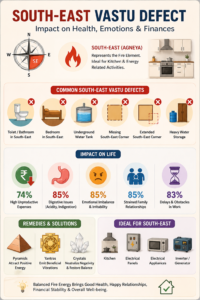

Why is the South-East Called the Fire Zone?
Fire has always been essential for human life. It helps in cooking food, providing warmth, preparing medicines, and supporting many industrial processes. In Vastu Shastra, fire symbolises much more than physical flames. It also represents energy, determination, confidence, motivation, and the ability to complete work.
This is why the kitchen is traditionally recommended in the South-East direction. When cooking activities take place in the Fire zone, they align with the natural qualities associated with this direction.
In today’s homes, the Fire element is also represented through modern appliances such as:
- Gas stove
- Oven
- Microwave
- Induction cooktop
- Electrical appliances
- Inverter systems
- Electrical panels
Their placement also becomes important while planning a property according to Vastu principles.
Ancient Roots of Vastu Shastra
Vastu Shastra is one of India’s oldest architectural sciences. Its principles have been discussed in several ancient texts that explain planning of homes, temples, cities, and public buildings.
References to Vastu are found in:
- Atharva Veda (Sthapatya Veda)
- Rig Veda
- Brihat Samhita
- Mayamatam
- Manasara
- Samarangana Sutradhara
- Vasturatnakar
These texts explain how buildings can be designed in harmony with natural forces such as sunlight, airflow, gravity, directions, and the five elements.
The objective of Vastu has never been to create fear. Its purpose is to help people build spaces that support comfortable living by making better use of natural energies available around us.
The Importance of Fire Element in Daily Life
Every home depends on the Fire element in some way. Cooking, lighting, electrical systems, heating, and many daily activities are connected with it.
According to traditional Vastu, a balanced Fire element supports:
- Healthy cooking environment
- Better utilisation of energy
- Positive enthusiasm
- Active lifestyle
- Smooth day-to-day functioning
On the other hand, an imbalance in this zone is traditionally believed to disturb the natural flow of fire energy within the property.
It is important to understand that Vastu does not claim that one single defect alone determines the future of a family. The overall balance of the property, the location of other directions, structural planning, and the way the house is used all play an important role.
How Modern Construction Creates South-East Vastu Defects
Modern residential projects are designed by considering factors such as available land, floor space index (FSI), parking requirements, plumbing lines, and architectural preferences. Because of these practical limitations, Vastu planning is not always given priority.
As a result, many homes today have rooms placed in locations that may not match traditional Vastu recommendations.
Some commonly observed South-East defects include:
- Kitchen located in another direction
- Toilet in the South-East
- Bedroom in the South-East
- Underground water tank in the South-East
- Missing South-East corner
- Extended South-East corner
- Main entrance in an unsuitable South-East position
- Heavy water storage in the Fire zone
These situations are frequently seen in apartments, independent houses, and even commercial properties.
However, every such layout should be assessed individually. The presence of one feature alone does not automatically indicate that serious problems will occur.
Research Conducted on Residential Properties
As part of my ongoing study of Vastu principles, I surveyed 325 residential properties where the South-East direction showed one or more traditional Vastu defects.
Each property was examined using established Vastu parameters. Information was also collected from residents regarding their experiences related to health, finances, emotions, and daily life.
The objective of this study was not to prove cause and effect. Instead, it was to observe whether certain experiences appeared repeatedly in homes with similar South-East conditions.
The findings presented in this article are based on these observations and should be understood alongside the broader principles of Vastu Shastra.
Every house is different. Two homes may have the same South-East defect, but the experiences of the families living there can be different. This is because Vastu does not assess one direction in isolation.
The complete layout of the property, the balance of all directions, and the placement of different rooms are considered together.
From my experience of studying residential and commercial properties, I have observed that many people are not aware of the exact location of the South-East direction. As a result, they may unknowingly create changes that disturb the Fire element.
How to Identify the South-East Direction in Your Home
Before looking for Vastu defects, you should correctly identify the South-East zone. Many people assume directions based on the position of the main door or the road outside the house. This approach can lead to incorrect conclusions.
The most reliable methods include:
- Using a good-quality magnetic compass
- Using a calibrated compass application on your mobile phone
- Referring to the building’s architectural layout
- Taking guidance from a qualified Vastu expert when needed
Stand at the centre of your house and locate the East and South directions. The area between these two directions forms the South-East or Agneya zone.
For accurate Vastu analysis, even a small error in identifying directions can change the observations. Therefore, it is important not to rely on guesswork.
Role of the South-East Zone in a House
According to Vastu Shastra, every direction has a specific purpose. The South-East direction is associated with activities that involve heat, fire, and energy.
Traditionally, this zone governs:
- Cooking activities
- Electrical energy
- Heat-producing appliances
- Enthusiasm and motivation
- Daily work efficiency
- Productive use of energy
When these activities are carried out in the appropriate direction, they are considered to be in harmony with the natural qualities of the Fire element.
Why the Kitchen is Recommended in the South-East
The kitchen is regarded as the most suitable room for the South-East direction because cooking involves the Fire element.
Traditional Vastu recommends that the cooking stove should ideally be placed so that the person cooking faces the East while preparing food. This arrangement is believed to support better utilisation of natural light during the morning hours and aligns with classical Vastu guidelines.
Modern kitchens also contain several electrical appliances. Locating them within the Fire zone creates functional consistency with the natural element represented by this direction.
If a kitchen cannot be placed in the South-East due to practical reasons, a detailed assessment of the property’s layout is advisable before making major changes.
Common South-East Vastu Defects
Due to changing construction practices, I frequently come across certain recurring defects during site inspections.
Some of the most common ones include:
Toilet in the South-East
Bathrooms and toilets involve water, while the South-East represents fire. According to traditional Vastu principles, placing water-related activities in the Fire zone creates an elemental imbalance.
Bedroom in the South-East
The South-East is considered an active and energetic zone. A bedroom, on the other hand, is meant for rest and relaxation.
Traditional Vastu suggests that this mismatch may not provide the calm environment generally preferred for sleeping.
Missing South-East Corner
Some plots or apartments have an irregular shape where the South-East corner is cut or missing.
Such layouts are commonly seen in modern residential projects due to space limitations. In Vastu, this is considered an important structural observation during property analysis.
Extended South-East Corner
In some buildings, the South-East corner projects outward beyond the regular shape of the plot.
This type of extension is also evaluated carefully because it may alter the proportional balance of the property according to Vastu principles.
Underground Water Tank in the South-East
Water storage is generally associated with the Water element. Locating an underground water tank in the Fire zone is traditionally considered an imbalance between two opposing elements.
Heavy Storage in the South-East
Large water drums, overhead water storage, or bulky water-related installations in the South-East are also noted during Vastu inspections.
The objective is to maintain the functional character of this direction as closely as possible.
Electrical Room in the South-East
Unlike water-related utilities, electrical equipment generally relates well to the Fire element.
For this reason, electrical panels, generators, inverter systems, and similar installations are often considered suitable for this direction when planned safely and according to engineering standards.


