
In my 28 years of practice, I’ve seen more people terrified by “Vastu experts” than by the actual problems in their homes. I’ve walked into houses where families were ready to tear down their kitchens because someone told them a South-East entrance would bring “ruin.”
Let’s be clear: Vastu is an environmental science, not a religious threat. It’s about how your house sits on the Earth’s magnetic grid and how the Sun’s rays hit your walls. If your consultant is telling you to “break a wall” without explaining the physics behind it, they aren’t practicing Vastu—they’re practicing superstition.
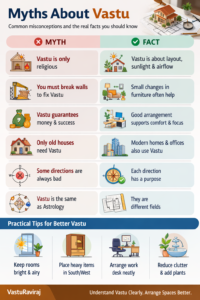
Vastu Myths: A Quick Reality Check
Before you spend a rupee on renovations, look at the actual science vs. the common myths I hear every day.
| The Fear (Myth) | The Science (Fact) |
| “My South-facing door is cursed.” | South-facing is excellent for Fame and Power if the entrance is in the right energy grid. |
| “I have to demolish my bedroom wall.” | We use Metallic Strips and Crystals to divert magnetic flux. No hammers needed. |
| “Vastu is only for Hindus.” | Do UV rays only hit Hindus? Vastu is Geomagnetism, it applies to every human on Earth. |
| “Vastu will fix my bank balance tonight.” | Vastu fixes your Circadian Rhythm and Focus. Your hard work fixes your bank balance. |
Do I Really Need to Demolish My House for Vastu?
This is the question I get asked most often. My answer is always: No.
In nearly three decades, I’ve developed remedies that act like “acupuncture” for a building. Think about it—if a human has a blocked artery, we use a stent, not a total body replacement. Your home is the same. We use specific color frequencies (VIBGYOR theory) and elemental balancers like Lead, Copper, or Brass to “tune” the energy. We don’t need to break bricks to fix a magnetic imbalance.
Is Vastu Shastra Scientific?
If you strip away the Sanskrit terms, Vastu is just Applied Physics.
The Solar Path: Managing Infra-Red and UV Rays
The Sun moves from East to West, but it doesn’t just give light; it gives radiation.
The Morning Sun (East): These rays are rich in Vitamin D and act as a natural disinfectant. This is why we want your house “open” here.
The Evening Sun (South-West): By 3 PM, the Sun emits high-intensity Infra-red rays. If your South-West walls are thin or have big windows, your house becomes a heat-trap, leading to irritability and “thermal stress” for the people living there. This isn’t “bad luck”—it’s a high body temperature causing bad moods.

The Magnetic Path: Your Body is a Compass
Your blood contains iron. The Earth is a giant magnet with a North and South Pole. When you sleep with your head to the North, the magnetic poles of your body and the Earth repel each other. This causes microscopic “static” in your blood circulation, leading to disturbed sleep. After 28 years of seeing patients with chronic fatigue, I can tell you: 90% of the time, it’s just their sleeping direction, not a ghost.
Vastu is About Optimisation
I always tell my clients: A house with a Vastu Dosha isn’t a cursed house; it’s an inefficient house. It’s like driving a car with the handbrake on. You’ll still reach your destination, but you’ll burn more fuel and wear out the engine. My job is to release that handbrake. We align your workspace with the Magnetic North to boost your decision-making and ensure your bedroom is in the Earth Element zone (South-West) so you actually wake up rested.
| The Common Fear (Myth) | The Scientific Reality (Fact) |
| “I must demolish my South-facing wall.” | We use Metallic Strips (Copper/Brass) to realign energy. No hammers needed. |
| “Vastu is a religious Hindu ritual.” | Vastu is Environmental Physics. It tracks Solar Radiation and Magnetic Flux. |
| “Vastu will make me rich overnight.” | Vastu optimizes your Circadian Rhythm and Focus, creating the environment for success. |
| “Ignoring Vastu brings a curse.” | There are no curses—only inefficient spaces that drain your energy and health. |
Stop Living in Fear
Vastu should give you peace of mind, not a headache. If you’re worried about your home’s layout, remember that there is always a scientific remedy that doesn’t involve a sledgehammer.


