
When people hear the word Vastu Shastra, many think it is only about placing rooms in the right direction or following traditional beliefs. In reality, Vastu Shastra is much more than that. It is an ancient Indian science of planning spaces that aims to create harmony between people and their surroundings.
Whether you are building a new home, buying a flat, planning an office, or setting up a factory, the design of the space plays an important role in your daily life. A well-planned building allows better sunlight, fresh air, smooth movement, and comfortable living. These principles have been valued in Vastu Shastra for thousands of years.
As a Vastu consultant, I often meet people after they have purchased a property. Many of them ask the same question:
“Would it have been better if I had consulted a Vastu expert before buying?“
In many cases, a proper evaluation at the planning stage could have helped them make a more informed decision. That is why understanding the importance of Vastu Shastra is valuable for anyone planning a home, commercial property, or industrial project.
The purpose of this article is to explain Vastu Shastra in simple language, clear common misconceptions, and help you understand why it continues to remain relevant in today’s world.
What is Vastu Shastra?
Vastu Shastra is an ancient Indian architectural science that provides guidelines for planning land, buildings, and interiors in harmony with nature.
The word “Vastu” means dwelling or structure, while “Shastra” means knowledge or science. Together, Vastu Shastra refers to the science of designing spaces that support comfortable and balanced living.
Unlike common belief, Vastu is not based on superstition. Its principles are derived from careful observations of nature, including:
- Sunlight
- Wind direction
- Open spaces
- Land slope
- Water placement
- Natural ventilation
- Balance of the five elements
These factors influence how a building functions and how people experience the space every day.
For centuries, kings, temple architects, and traditional builders used these principles while designing temples, forts, homes, and cities. Even today, many of these principles continue to be considered during modern architectural planning.
The goal of Vastu Shastra is not to change your destiny. Instead, it aims to create an environment that supports comfort, functionality, and harmony.
Why is Vastu Shastra Important?
Every building affects the people who live or work inside it.
Think about entering two different homes.
One feels bright, airy, and peaceful.
The other feels dark, congested, and uncomfortable.
Even without knowing anything about Vastu, most people can sense the difference.
Vastu Shastra helps create spaces that make better use of natural light, airflow, and directional planning. When these factors are considered during construction, the building often becomes more comfortable and practical for everyday living.
From my experience of consulting on residential, commercial, and industrial projects, I have noticed that many construction-related issues arise because planning begins without understanding the site’s natural characteristics.
Proper planning at the beginning is often simpler and more economical than making changes after construction is completed.
This is one of the biggest reasons why Vastu is considered important.
It encourages thoughtful planning before decisions become expensive to change.
The Main Objectives of Vastu
Many people believe Vastu is only about choosing the right direction.
In reality, its objectives are much broader.
A well-planned property aims to achieve:
- Better use of natural sunlight
- Proper ventilation
- Comfortable movement within the building
- Balanced distribution of open and built-up spaces
- Efficient room placement
- Better utilisation of land
- Harmony with natural elements
These principles improve both functionality and comfort.
When architecture works with nature instead of against it, the overall living experience often becomes more pleasant.
How Vastu Shastra Works with Nature
Nature follows its own rhythm.
The sun rises in the east every morning.
The direction of wind changes throughout the day.
Heat and light move differently across different parts of a building.
Vastu Shastra studies these natural patterns and recommends planning spaces accordingly.
For example:
A kitchen that receives morning sunlight may remain brighter and drier.
Living areas with good ventilation usually feel more comfortable.
Proper placement of windows improves airflow naturally.
These are practical observations that continue to remain useful even in modern construction.
Vastu encourages designing buildings that work with these natural forces rather than ignoring them.
The Five Elements in Vastu Shastra
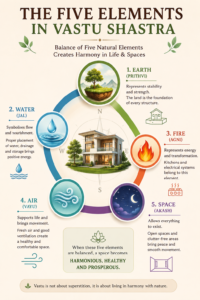
One of the foundations of Vastu Shastra is the balance of the five natural elements, also known as the Panch Mahabhutas.
According to ancient Indian knowledge, everything in nature is made up of these five elements.
Earth (Prithvi)
Earth represents stability and strength.
The land on which a building stands forms the foundation of every structure. Choosing an appropriate plot and understanding its characteristics are important aspects of Vastu planning.
Water (Jal)
Water symbolises flow and nourishment.
Its placement within a property has always received special attention in traditional Vastu planning.
Proper drainage, water storage, and natural water movement are considered during site evaluation.
Fire (Agni)
Fire represents energy and transformation.
In modern homes, kitchens and electrical systems are closely associated with this element.
Planning these areas carefully improves both functionality and safety.
Air (Vayu)
Air supports life.
Fresh air entering the building improves ventilation and indoor comfort.
Buildings with good airflow generally feel healthier and more pleasant than enclosed spaces with poor ventilation.
Space (Akash)
Space is the element that allows everything else to exist.
An overcrowded building often feels uncomfortable regardless of its size.
Maintaining balanced open areas helps improve movement and creates a sense of openness.

Why Balancing the Five Elements Matters
The purpose of balancing these five elements is not ritualistic.
Instead, it encourages architects and homeowners to think about how different parts of a building interact with nature.
For example,
A home with adequate ventilation, sufficient natural light, proper drainage, and thoughtfully planned open spaces usually provides a better living experience than one that ignores these factors.
This balance is one of the core principles of Vastu Shastra.
Vastu Shastra and Modern Architecture
Some people assume that Vastu and modern architecture cannot work together.
In my experience, they often complement each other.
Modern architects focus on structural safety, functionality, aesthetics, and engineering.
Vastu adds another layer by considering orientation, directional planning, natural elements, and site characteristics.
Many successful residential and commercial projects combine architectural design with Vastu principles right from the planning stage.
This approach helps avoid unnecessary compromises later.
Rather than replacing architecture, Vastu works alongside it.
Is Vastu Shastra Relevant Today?
This is one of the most common questions people ask.
My answer is simple.
Yes, Vastu continues to remain relevant because the natural forces around us have not changed.
The sun still rises in the east.
Wind still follows seasonal patterns.
Natural light remains important.
Ventilation continues to influence indoor comfort.
Every building still depends on thoughtful planning.
Although construction methods have evolved, these natural principles continue to remain the same.
That is why Vastu Shastra still finds relevance in homes, apartments, offices, hospitals, hotels, educational institutions, commercial complexes, and industrial units across India and many other countries.
Eight Directions in Vastu Shastra
One of the most important concepts in Vastu Shastra is the eight directions. Every direction receives different levels of sunlight, wind, heat, and natural energy throughout the day. Vastu studies these natural characteristics and recommends suitable uses for each part of a building.
The purpose is not to make every property look the same. Instead, it helps in planning spaces according to their natural strengths.

North
The North direction is traditionally associated with opportunities and movement. In many residential and commercial projects, this side is planned to remain open and well maintained.
North-East (Ishan)
The North-East is considered one of the most important zones in Vastu. It usually receives soft morning sunlight, making it suitable for calm and peaceful activities. This area is often preferred for prayer rooms, meditation spaces, or open areas.
East
The East welcomes the rising sun. Proper openings in this direction can allow natural morning light to enter the building, creating a bright and fresh environment.
South-East (Agni)
This direction is associated with the Fire element. It is commonly recommended for kitchens in homes because cooking naturally relates to heat and fire.
South
The South receives stronger sunlight during the day. Proper planning helps maintain thermal comfort while ensuring the building remains functional.
South-West (Nairutya)
The South-West represents stability. In many residential layouts, this direction is preferred for the master bedroom because it provides a sense of permanence and balance.
West
The West receives afternoon sunlight. Proper shading and ventilation become important while planning this side of the property.
North-West (Vayu)
This direction is linked with movement and airflow. Guest rooms, storage, or utility areas are commonly planned here depending on the property’s layout.
Every property is unique. A professional Vastu analysis considers the overall layout instead of judging a building based on one direction alone.
What is the Vastu Purusha Mandala?

The Vastu Purusha Mandala is the foundation of Vastu planning.
It is a geometric diagram that divides a property into different zones. Each zone represents a specific direction and has its own functional significance.
Rather than looking at a house as a collection of rooms, the Mandala views the entire property as one balanced system.
This planning method helps architects and Vastu consultants decide the most suitable locations for important areas such as:
- Entrance
- Kitchen
- Bedrooms
- Living room
- Staircase
- Water storage
- Open spaces
- Toilets
- Parking
Even today, many architects study this concept while designing buildings because it provides a systematic approach to space planning.
Why is the Brahmasthan Important?
The centre of the Vastu Purusha Mandala is known as the Brahmasthan.
It is considered the heart of the building.
Traditionally, this area is kept as open and clutter-free as possible.
In old Indian homes, central courtyards were commonly built in this location. They allowed sunlight, ventilation, and better movement of air throughout the house.
Modern apartments may not always have an open courtyard, but avoiding excessive congestion in the central area can still improve the overall flow within the home.
Importance of Vastu for Homes
A home is where families spend most of their lives.
Good planning can improve comfort, convenience, and day-to-day living.
Vastu encourages homeowners to consider practical aspects such as:
- Proper room placement
- Natural lighting
- Fresh airflow
- Functional movement
- Balanced open spaces
- Comfortable orientation
These factors contribute to a better living environment.
From my experience, many homeowners focus only on interior decoration after purchasing a property. However, the basic layout of the house has a much greater influence on how the space functions every day.
Planning correctly at the beginning often saves unnecessary changes later.
Importance of Vastu for Apartments
Many people believe Vastu only applies to independent houses.
This is a common misconception.
Vastu principles can also be considered while selecting an apartment.
Some important aspects include:
- Direction of the main entrance
- Shape of the flat
- Placement of kitchen
- Bedroom locations
- Balcony direction
- Natural light
- Ventilation
- Overall floor plan
Since structural changes in apartments are limited, choosing a well-planned flat before purchase becomes even more important.
Importance of Vastu for Offices
A well-designed office should support productivity, teamwork, and smooth daily operations.
Vastu planning considers factors such as:
- Entrance location
- Seating arrangement
- Cabin placement
- Meeting rooms
- Reception
- Pantry
- Open workspace
- Natural lighting
These recommendations aim to create a comfortable and organised work environment.
Today, many businesses consult Vastu experts during the planning stage because correcting layouts after office interiors are completed can be expensive.
Importance of Vastu for Shops and Commercial Spaces
The design of a commercial property influences how customers move through the space.
Important considerations include:
- Entrance planning
- Product display
- Cash counter location
- Customer movement
- Storage areas
- Lighting
- Open circulation
Whether it is a retail showroom, medical clinic, restaurant, or shopping outlet, careful planning improves functionality and customer experience.
Vastu does not replace good business practices, but it supports thoughtful space planning.
Importance of Vastu for Factories and Industrial Units
Industrial projects involve significant investment.
Once construction begins, making major structural changes becomes difficult.
That is why Vastu planning is often considered during the initial stages.
For manufacturing units, attention is usually given to:
- Plot selection
- Building orientation
- Heavy machinery placement
- Administrative offices
- Raw material storage
- Finished goods storage
- Loading and unloading zones
- Utility services
- Worker movement
In my professional experience, industrial Vastu is less about individual rooms and more about ensuring that the overall layout supports smooth operational flow.
Importance of Vastu Before Buying Land
One of the biggest mistakes people make is consulting a Vastu expert only after purchasing land.
It is always better to evaluate the plot before making the investment.
A professional site analysis generally considers:
- Plot shape
- Road position
- Surrounding environment
- Slope of land
- Existing structures
- Nearby water bodies
- Electrical installations
- Future construction possibilities
Choosing the right plot gives greater flexibility during planning and construction.
Importance of Vastu Before Buying a Ready Property
Buying a ready-built house or apartment is different from constructing a new home.
Since major structural modifications may not be possible, it is advisable to understand the property’s overall layout before finalising the purchase.
A professional assessment can help you understand both the strengths and limitations of the property so that you can make an informed decision.
This approach is far better than discovering important issues after moving in.
Vastu Should Be Considered During the Planning Stage
One lesson I have learned from years of consulting is simple.
The earlier Vastu is considered, the easier the planning process becomes.
When architects, engineers, builders, and Vastu consultants work together from the beginning, the project usually requires fewer compromises.
This approach applies to:
- Homes
- Villas
- Apartments
- Commercial buildings
- Hotels
- Hospitals
- Educational institutions
- Industrial projects
Early planning saves both time and unnecessary modifications later.
Is There Any Scientific Perspective Behind Vastu?
One question I am often asked is, “Is Vastu Shastra scientific?”
The answer requires a balanced understanding.
Vastu Shastra is an ancient architectural system, not a branch of modern science. At the same time, many of its recommendations are based on practical observations of nature that are still relevant today.
For example:
- Making the best use of natural sunlight
- Planning for proper ventilation
- Keeping enough open space around a building
- Designing rooms according to their function
- Considering climate while planning a structure
These principles are also valued in modern architecture and sustainable building design.
Some traditional Vastu concepts are based on cultural and spiritual beliefs, while others have clear practical benefits. It is important to understand both with an open and balanced approach.
Instead of viewing Vastu as magic or superstition, it is better to see it as a traditional system of space planning that has evolved through centuries of observation and experience.
Can Existing Buildings Benefit from Vastu?
Absolutely.
Many people think Vastu is useful only while constructing a new building. In reality, a large number of consultations involve homes, offices, shops, and factories that are already built.
Every existing property is different. Some may require no changes at all, while others may benefit from simple improvements in planning, usage, or space organisation.
In many cases, practical recommendations may include:
- Better use of natural light
- Rearranging furniture
- Improving ventilation
- Removing unnecessary clutter
- Using rooms according to their intended purpose
- Making minor layout adjustments where possible
Not every property needs major structural changes.
A professional Vastu consultation focuses on understanding the strengths of the existing property and identifying practical improvements wherever possible.
Common Misconceptions About Vastu
Over the years, I have come across many myths that create unnecessary confusion. Let us look at some of the most common ones.
Myth 1: Every Home Has Serious Vastu Defects
This is not true.
No property is absolutely perfect, and no property is automatically considered unsuitable because of one particular feature.
A proper Vastu assessment always considers the complete layout before arriving at any conclusion.
Myth 2: Vastu Is Only for Hindus
Vastu Shastra is a system of architectural planning.
People from different cultures, religions, and countries consult Vastu experts while planning their homes and commercial spaces.
Its principles relate to the design of buildings rather than religious identity.
Myth 3: Every Problem in Life Is Caused by Vastu
Life is influenced by many factors.
Health, education, financial planning, personal decisions, family relationships, and hard work all play important roles.
Vastu should never be seen as the only reason behind success or difficulties.
It is simply one aspect of planning a better living or working environment.
Myth 4: Every Vastu Issue Requires Demolition
Fortunately, this is not true.
Many people become worried after hearing that major demolition is the only solution.
In reality, several situations can be addressed through planning, better space utilisation, or minor modifications, depending on the property’s condition.
Every case is unique.
Myth 5: Vastu Guarantees Success
No responsible Vastu consultant should make such a promise.
Success depends on knowledge, effort, planning, discipline, teamwork, and many other factors.
Vastu supports good planning of physical spaces. It should not be viewed as a guarantee of specific life outcomes.
Simple Vastu Tips for Everyday Living
You do not need to build a new house to appreciate the basic principles of Vastu.
Some simple practices can make your home feel more organised and comfortable.
Allow Natural Light
Keep windows clean and allow daylight to enter whenever possible.
Natural light makes spaces feel brighter and more welcoming.
Maintain Good Ventilation
Fresh air improves indoor comfort.
Proper ventilation also helps reduce dampness and keeps rooms feeling fresh.
Keep the Centre of the House Organised
Avoid filling the central part of your home with unnecessary heavy storage or clutter whenever possible.
Open movement contributes to a more comfortable living environment.
Keep Your Home Clean
Clean surroundings improve both hygiene and the overall appearance of a property.
Regular maintenance also increases the lifespan of the building.
Plan Before Renovating
Before making major structural changes, seek professional advice.
Proper planning often prevents unnecessary expenses later.
Why Professional Vastu Consultation Matters
Every property has its own characteristics.
Two houses facing the same direction may have completely different layouts.
That is why Vastu should never be judged using short online videos or general checklists alone.
A professional consultation studies several factors together, including:
- Plot dimensions
- Building orientation
- Room placement
- Road position
- Surrounding structures
- Land slope
- Open spaces
- Functional requirements of the occupants
Only after evaluating the complete property can meaningful recommendations be made.
As a Vastu consultant, I believe every recommendation should be practical, easy to understand, and suitable for the individual property.
Frequently Asked Questions
What is the main purpose of Vastu Shastra?
The main purpose of Vastu Shastra is to help plan buildings in harmony with natural elements such as sunlight, airflow, space, water, and land.
Is Vastu Shastra useful for modern apartments?
Yes. Even though structural changes may be limited, Vastu principles can still be considered while selecting an apartment and planning its interiors.
Can Vastu be followed in small homes?
Certainly.
The size of a property does not determine whether Vastu principles can be considered. Good planning is possible in both small and large homes.
Is Vastu only useful before construction?
No.
Although planning before construction offers greater flexibility, existing buildings can also benefit from practical improvements wherever possible.
Should I consult a Vastu expert before buying property?
Yes.
Understanding the strengths and limitations of a property before making a significant investment helps you make a more informed decision.
Does Vastu apply to offices and commercial buildings?
Yes.
Many offices, shops, hotels, factories, hospitals, and educational institutions consider Vastu during planning because good layouts improve functionality and efficient use of space.
Can Vastu and modern architecture work together?
Absolutely.
Modern architecture focuses on structural design and functionality, while Vastu provides additional guidance on orientation, space planning, and harmony with natural elements.
Both can complement each other.
Is Vastu relevant outside India?
Yes.
Although Vastu originated in India, its basic principles of sunlight, ventilation, orientation, and functional planning can be applied anywhere in the world.
Over the years, I have seen that every property is unique. Rather than applying the same rules everywhere, it is important to evaluate each site individually and understand its strengths before making recommendations.
At VastuRaviraj, our approach has always been to educate property owners and provide practical guidance based on careful analysis and years of professional experience. The objective is not to create fear or make unrealistic promises, but to help people make informed decisions while planning their homes, workplaces, and commercial spaces.
A well-planned building is not only easier to use, but it also becomes a place where people feel comfortable, organised, and connected with their surroundings. That is the true importance of Vastu Shastra.


