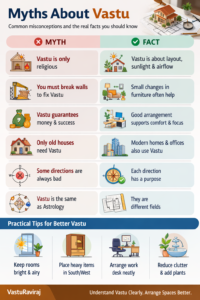
Vastu Shastra is often misunderstood as a mystical practice. In reality, it originated as a system of architectural guidelines developed in ancient India to harmonize buildings with natural forces.
When we examine traditional Vastu principles through a modern lens, many of them align with environmental science, solar movement, and magnetic orientation.
In my 28 years of consulting experience, I have observed that the most successful Vastu implementations are those that treat it as spatial optimization rather than superstition.
Ancient architects designed buildings by observing:
- Sunlight movement throughout the day
- Prevailing wind directions
- Earth’s magnetic field
- Thermal comfort and ventilation
Modern architecture and sustainable design use similar principles today.
Therefore, Vastu can be understood as a traditional environmental design framework rather than a belief system.
Vastu Myths: Quick Reality Check
| Common Vastu Myth | Scientific Reality |
|---|---|
| Vastu means breaking walls and rebuilding the house | Most Vastu corrections are non-structural adjustments such as space usage, layout balance, lighting, ventilation, and placement changes |
| Vastu is a religious ritual meant only for Hindus | Vastu is an ancient Indian architectural and environmental science that studies sunlight, airflow, orientation, and spatial energy |
| If the house is not as per Vastu, bad luck will happen | Vastu focuses on environmental optimization, not punishment or superstition |
| A Vastu expert will tell you to demolish your property | Professional Vastu analysis first suggests practical corrections without demolition |
| Following Vastu will instantly make you rich | Vastu can support productivity, mental clarity, and stability, but success still depends on effort and decisions |
| Vastu defects create fear or negative destiny | In reality, Vastu studies how design influences human behaviour, comfort, and performance |

Do I Need to Demolish My House for Vastu?
One of the biggest fears people have is that a Vastu consultant will ask them to break walls or reconstruct the property.
This is one of the most widespread myths.
In practical consulting, demolition is rarely required.
In my experience of nearly three decades, more than 80–90% of corrections can be implemented without structural changes.
Non-Structural Vastu Remedies
Instead of demolition, professionals focus on space optimization, such as:
- Correct room usage
- Improving natural light flow
- Adjusting furniture placement
- Managing entry orientation
- Enhancing ventilation and airflow
- Correcting functional zones of activity
For example:
- A workspace shifted toward a better directional alignment can improve focus.
- Increasing natural light in certain areas improves mood and productivity.
- Decluttering blocked zones improves airflow and circulation.
These changes are architectural adjustments, not destructive renovations.
Vastu is about improving how a space functions, not damaging it.
Is Vastu Only for Hindus or Religious People?
Another misconception is that Vastu Shastra belongs only to a particular religion.
In reality, Vastu is based on universal natural principles that affect every building regardless of culture, belief, or geography.
These include:
- Solar radiation
- Wind movement
- Magnetic orientation of the earth
- Human interaction with built environments
Architectural traditions around the world follow similar ideas.
For example:
- Japanese architecture emphasizes sunlight and spatial balance
- Scandinavian design focuses on natural light optimization
- Modern green architecture studies thermal and energy efficiency
Vastu simply represents India’s traditional approach to environmental architecture.
The principles work because they align with physics and environmental design, not because of religion.
Can Vastu Make Someone Rich Overnight?
Many people approach Vastu expecting instant financial miracles.
This expectation creates disappointment and confusion.
The truth is simple.
Vastu does not replace effort, skill, or decision-making.
Instead, it works as a support system for human performance.
A well-designed environment can influence:
- Mental clarity
- Stress levels
- Productivity
- Focus and decision making
For example, studies in environmental psychology show that lighting, spatial layout, and ventilation directly affect concentration and mood.
If a workspace improves focus and reduces distractions, it can indirectly support better work output.
But success always requires consistent action and discipline.
Vastu supports the environment in which success can grow.
It does not create success automatically.
The Science of Directions in Vastu
One of the core foundations of Vastu is the study of directional influence.
These directions are not mystical ideas.
They are connected to solar movement and the Earth’s magnetic field.
Solar Path: East to West
The sun rises in the East and sets in the West.
This daily solar movement influences:
- Light exposure
- Heat gain
- Infra-red radiation
- Ultraviolet (UV) radiation
Traditionally, Vastu recommends:
- Open or active spaces toward the East to receive healthy morning sunlight.
- Controlled exposure in the West to reduce excessive afternoon heat.
Morning sunlight contains balanced light spectrum and moderate UV exposure, which can improve mood and regulate biological rhythms.
Proper architectural orientation can also help with UV ray management and thermal comfort.
Magnetic Path: North to South
The Earth functions like a giant magnet with a magnetic flux flowing roughly from North to South.
Many Vastu principles align human activity with this natural magnetic orientation.
For example:
- Workspaces oriented toward North or East often feel mentally comfortable because they align with natural spatial orientation.
- Sleeping orientation sometimes considers magnetic field alignment, which may influence relaxation and biological rhythms.
While these ideas were historically observed empirically, modern science also studies geomagnetic influence on biological systems.
Why Fear-Based Vastu Advice Is Misleading
Fear-based advice is one of the biggest reasons people misunderstand Vastu.
Statements such as:
- “Your house will bring bad luck.”
- “This direction will destroy your success.”
- “You must rebuild everything.”
These claims create unnecessary anxiety.
In professional practice, Vastu is not about predicting doom.
It is about identifying spatial inefficiencies and correcting them logically.
A house is simply a built environment.
Like any environment, it can be optimized for better comfort and performance.
Vastu should always be applied in a calm, analytical, and practical way.
Vastu Is About Optimization, Not Punishment
The most important thing to understand is that Vastu is not a system of punishment.
It does not label buildings as cursed or unlucky.
Instead, it studies how architecture interacts with natural energy patterns such as sunlight, airflow, and directional balance.
In my 28 years of professional experience, I have seen that small changes in spatial arrangement can significantly improve:
- Workplace productivity
- Home comfort
- Mental clarity
- Business workflow
When applied responsibly, Vastu becomes a tool for improving the relationship between people and their spaces.
Should You Get a Scientific Vastu Audit?
If you are curious about Vastu but worried about drastic changes, the best approach is to start with a scientific assessment of your space.
A professional analysis focuses on:
- Directional orientation of the building
- Natural light and ventilation patterns
- Functional zoning of rooms
- Entry and circulation flow
- Workspace and productivity alignment
The goal is always practical improvement without unnecessary demolition.
A well-guided Vastu audit helps you understand how your environment influences your daily life and what adjustments can improve it.
A Final Thought from 28 Years of Practice
After working with residential homes, offices, factories, and commercial spaces for nearly three decades, one conclusion remains consistent.
Buildings influence human behaviour more than we realize.
When design aligns with natural forces such as sunlight, airflow, and directional balance, the environment becomes more supportive.
That is the real purpose of Vastu.
If you wish to understand how these principles apply to your property, consider getting a scientific Vastu analysis of your space — with practical corrections and no demolition required.