
Banks handle large volumes of cash, sensitive financial data, and public transactions every day. Because of this, the spatial organization of a bank branch directly affects operational stability, security management, and workflow efficiency.
In my 28 years of consulting on commercial Vastu projects, including financial institutions, corporate offices, and large commercial developments, I have observed that banks that follow a structured spatial layout often experience better operational coordination, controlled financial movement, and stronger security discipline.
This guide explains Vastu for bank branch layout from a technical and architectural perspective so that bank managers, architects, and developers can design efficient banking environments.
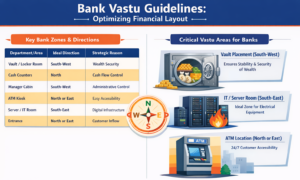
Bank Zone Quick-Reference Table
| Department / Area | Ideal Direction | Strategic Reason |
|---|---|---|
| Bank Entrance | North or East | Supports steady customer inflow and smooth transaction movement |
| Cash Counter / Cashier Desk | North facing | Encourages controlled financial flow and transparency |
| Locker Room / Vault | South-West | Provides stability and security for high-value assets |
| Manager Cabin | South-West or South | Ensures authority and administrative control |
| Loan & Advisory Desk | North-East | Improves clarity in financial decision-making |
| ATM Kiosk | North, East or North-East | Allows easy public accessibility |
| Server / IT Room | South-East | Ideal zone for electrical infrastructure |
| Waiting Area | North or East | Maintains smooth circulation of visitors |
| Records & Documents Storage | West or South-West | Suitable for storing heavy documents securely |
Vastu Principles Behind Bank Branch Planning
Financial institutions operate on three critical functional pillars:
- Security of wealth
- Smooth transaction movement
- Operational authority
In Vastu planning, these correspond to:
- South-West (Earth Element) – stability, protection of assets
- North (Financial Flow Zone) – controlled movement of money
- South (Authority Zone) – administrative control
When these zones are aligned correctly in a bank branch layout, it can support operational discipline and risk management.

Vastu for Bank Entrance: Managing Customer Flow
The bank entrance acts as the primary interface between the institution and the public. Its location influences customer circulation, staff coordination, and security monitoring.
Ideal Direction
North or East facing entrance
Strategic Reason
- The North direction is traditionally associated with financial movement and transactions.
- The East direction supports visibility and openness in commercial spaces.
Practical Layout Guidelines
- Entrance should remain well illuminated and obstruction-free.
- Avoid placing heavy security cabins directly blocking the entrance.
- Customer flow should naturally move toward transaction counters without congestion.
In modern branch design, architects often combine North-East entry with central transaction counters, which supports both Vastu alignment and security camera coverage.
Optimizing Cash Flow: The Vastu of Cash Counters
The cash counter area is the operational core of the bank. Every deposit, withdrawal, and financial exchange passes through this zone.
Cashier Desk Direction
The cashier desk direction should ideally face North.
Strategic Logic
- Facing North allows clear visual communication with customers.
- It symbolically represents controlled outward financial movement, which is important in banking operations.
Layout Recommendations
- Counters should ideally be positioned in the North zone of the branch interior.
- Cash drawers should open toward the North or East.
- Avoid placing cash counters directly under staircases or beams, as this may create workflow congestion.
A well-designed cash counter layout also helps security staff monitor financial transactions effectively.
The Security Zone: Locker Rooms and Vault Placement
Among all departments in a bank, locker rooms and vaults require the highest level of security stability.
Ideal Location
South-West direction of the branch
Earth Element Logic
In Vastu science, the South-West zone represents the Earth element, which symbolises:
- stability
- permanence
- weight
Because vaults store high-value assets such as cash reserves, gold, and confidential documents, placing them in this direction helps maintain structural and energetic stability.
Technical Planning Guidelines
- Vault doors should ideally open toward the North or East.
- Walls around the vault area should be structurally strong and reinforced.
- Avoid locating locker rooms in North-East or central zones.
In large financial institutions, double security chambers located in the South-West block often align both security engineering and Vastu logic.
Bank Manager Cabin Vastu: Leadership and Administrative Control
The bank manager’s cabin is the command centre for branch operations. Placement of this cabin influences decision-making authority and administrative oversight.
Ideal Placement
South-West or South zone of the branch
Strategic Reason
These zones represent authority, stability, and leadership control.
Practical Layout
- The manager should ideally sit facing North or East.
- The cabin should have clear visibility of the main transaction hall.
- Avoid placing the manager cabin in North-East, which should remain open and light.
This arrangement ensures clear hierarchical structure within the branch layout.
Modern Banking Infrastructure: IT and Server Room Vastu
Modern banking operations rely heavily on digital infrastructure, servers, and communication equipment.
These systems require a stable electrical environment and minimal downtime.
Ideal Location
South-East direction
Fire Element Logic
The South-East zone represents the Fire element, traditionally associated with:
- electricity
- heat
- technological equipment
Because servers and data systems generate heat and require electrical power, this zone supports functional alignment with infrastructure requirements.
Technical Guidelines
- Server racks should face East or South-East.
- Cooling systems should be installed efficiently.
- Avoid placing server rooms in North-East or South-West zones.
This planning supports a reliable IT infrastructure for digital banking services.
ATM Integration: Vastu Guidelines for ATM Kiosks
ATM kiosks are often attached to bank branches or placed externally for 24-hour access.
Ideal ATM Location
- North
- East
- North-East
Strategic Reason
These directions allow easy public accessibility while maintaining visibility and surveillance.
ATM Planning Tips
- ATM machines should ideally face North or East.
- Avoid placing ATMs in South-West zones, which should remain secure for internal banking assets.
- ATM kiosks should maintain good lighting and security camera coverage.
When ATM kiosks are placed correctly, they support smooth customer usage without interfering with internal banking operations.
Customer Waiting Area and Circulation Design
A well-planned bank branch must maintain efficient visitor circulation.
Ideal Zones
North and East areas
Design Recommendations
- Seating should not block the cash counter visibility.
- Waiting areas should be well lit and comfortable.
- Avoid overcrowding in the central transaction zone.
This arrangement ensures orderly customer flow during peak banking hours.
Document Storage and Records Management
Banks maintain large volumes of loan records, legal documents, and financial files.
Ideal Direction
West or South-West
Reason
These directions are suitable for heavy storage systems and long-term document preservation.
Layout Tips
- Use strong storage cabinets.
- Avoid storing sensitive records in North-East zones.
Correcting Vastu Defects in Rented Bank Properties
Many banks operate in rented commercial spaces where structural changes are limited. In such cases, non-invasive Vastu corrections can help balance directional imbalances.
Entrance Direction Remedies
If the entrance falls in a less favourable zone:
- Improve lighting intensity near the entrance.
- Use metal elements or reflective surfaces to redirect energy flow.
Cash Counter Corrections
If the cashier desk direction cannot face North:
- Adjust seating orientation internally.
- Use appropriate colour elements in the counter design.
Locker Room Adjustments
If the vault is not in the South-West:
- Strengthen the area with heavy storage structures.
- Use earth-tone interiors to stabilise the zone.
IT Room Adjustments
If the server room cannot be placed in South-East:
- Ensure strong electrical grounding.
- Maintain controlled lighting and cooling systems.
These remedies allow banks to improve spatial balance without structural reconstruction.
Why Professional Vastu Planning Matters for Financial Institutions
Banks are complex environments involving:
- financial security systems
- customer service zones
- digital infrastructure
- confidential data storage
A carefully planned bank branch layout based on Vastu principles can support:
- efficient transaction flow
- strong administrative control
- better infrastructure organisation
- improved security planning
For architects and real estate developers designing financial institutions, integrating Vastu principles during the design phase helps avoid layout conflicts later.
Commercial Vastu Consultation for Banks
Designing or renovating a bank branch requires technical planning that aligns architecture, workflow, and security systems.
With 28 years of professional experience in commercial Vastu consulting, I have guided numerous projects, including bank branches, corporate offices, manufacturing units, and financial institutions.
If you are planning:
- a new bank branch
- ATM network expansion
- financial office renovation
- commercial property development for banks
you may consider a Commercial Site Audit for detailed layout evaluation.
A professional Vastu assessment can help ensure that the branch design supports operational efficiency, financial stability, and long-term institutional growth.


